Memorylake
Mar 2, 2026
"Your brain is for having ideas, not holding them."
——Tiago Forte, Building a Second Brain
LLMs are AI's 'First Brain'; memory platforms are AI's 'Second Brain.'
In his bestselling book Building a Second Brain, Tiago Forte shared a core insight: "The biological brain is for generating ideas, while an external system is for the reliable, infinite storage of information." This perspective offers profound insight for understanding the division of labor between AI's "two brains."
Indeed, an LLM functions as AI's "First Brain" (the biological counterpart). It excels at thinking, reasoning, and real-time generation, but it is not designed for the long-term, precise storage of vast factual knowledge.
A memory platform serves as AI's "Second Brain." Its primary role is to provide accurate "memory" support to LLMs on demand, liberating them from the burden of memorization so they can focus on higher-level reasoning and creation. The synergy between the two—the memory platform responsible for "remembering everything" and the LLM for "thinking through everything"—produces more accurate, personalized, and actionable value.
As AI Moves from Pilots to Core Enterprise Operations, Memory Platforms Become the Critical Deciding Factor
Over the past few years, enterprise AI applications have traversed three distinct phases:
1.0 The Connectivity Phase (Pre-2023): Solving 'Storage' and 'Findability'
Early AI acted as an intelligent connector, ingesting enterprise data into vector databases to enable semantic search, enhancing user input beyond traditional keyword matching.
Limitation: It remained distant from core production processes—more of a "smarter document manager" that didn't touch the substance of business operations.
2.0 The Interaction Phase (2023-2024): Intent Understanding and the 'Hallucination' Predicament
Breakthroughs in large models allowed AI to interact with data via natural language conversations, lowering barriers to entry.
Emerging Bottleneck: While it could handle explicit data, it struggled to represent the "tacit knowledge" within expert minds (e.g., a venture capitalist's intuition spotting issues in financial reports), leading to superficial outputs and unreliable decision support.
3.0 The Productivity Era (2025-Present): Extracting 'Tacit Knowledge' and Solidifying Core Assets
Industry focus has pivoted sharply toward directly enhancing productivity. The critical leap lies in digitizing and tracing the trajectory of tacit knowledge—the decision-making logic, experience, and trade-offs of employees.
This is no longer simple Q&A. It involves recording and analyzing daily employee activities like approvals, annotations, and communications to construct an organizational "decision trajectory memory hub," enabling the sediment and reuse of core capabilities.
Today, competition has escalated to the "memorization of tacit knowledge" and the highly accurate, reliable, and trustworthy management of that memory. A "memory platform" is no longer just a supporting tool; it is the mechanism for transforming a company's most valuable intellectual asset—the judgment within human minds—into a iterable, inheritable memory asset.
Analysts project that by 2030, the market for AI agent orchestration and memory systems will reach $28.45 billion, with $12.88 billion attributable to the standalone AI memory market.
What Defines a World-Class AI Memory Platform?
A sophisticated AI memory platform is far more than just a system for "storing and retrieving." It must possess three core competencies: data understanding model capabilities, memory management and computation, and a multimodal data platform.
DataCloud recently launched MemoryLake, the industry's first product with large-scale, real-world implementation of these principles. As one of the few global players with a full-stack capability spanning memory technology, models, and data platforms, DataCloud is pioneering a memory-centric technical roadmap with MemoryLake.
As early as 2023, Ethan, founder of DataCloud, began formulating a vision: "Memory, as AI's second brain, will give rise to an entirely new AI infrastructure layer built around it."
He predicted that the core of future systems would shift from "managing data records" to "managing multimodal decision trajectories to construct multimodal cognitive state memory." Cognitive state memory—a system's structured internal representation at a given moment of "what I'm doing, what I know, what I assume, and what I'm uncertain about"—would become the central construct of the AI era.
Guided by this vision, the team first launched Powerdrill in 2024, a decision-making agent designed for high-accuracy, low-tolerance, serious-use-case scenarios. Through iterations and accuracy refinements involving over 1.5 million professional data users overseas, 13 million data-related questions, and 50 million lines of generated code (each user query dynamically generates a decision software instance), they accumulated a comprehensive set of end-to-end memory engineering techniques. This groundwork culminated in today's productized MemoryLake.
MemoryLake comprises three core technological components: the MemoryLake-D1 Large Language Model, the MemoryLake Engine, and the Relyt Multi-modal Data Cloud. For the first time, it integrates a full-stack capability encompassing "deep multimodal content understanding, memory computation and management, and multimodal memory storage."
Based on practices with industry-leading clients, MemoryLake demonstrates enterprise-grade readiness for hyperscale memory scenarios (e.g., managing over 10 trillion records and 100 million documents in some client production systems). It serves clients including one of the world's largest office document platforms, a leading enterprise mobile office software provider, and major foundation model companies. In competitive evaluations against global cloud giants and prominent AI vendors, MemoryLake shows significant advantages in cost, accuracy, recall, and latency.
Early this year, MemoryLake officially launched, translating the three core capabilities mentioned above into practical functionality directly applicable to enterprise scenarios.
Memory Management Capabilities
MemoryLake manages memory through a layered approach, categorizing it into short-term, medium-term, and long-term memory, along with specialized types like working memory and world model memory. It dynamically stores information based on access frequency, reuse value, and lifecycle, balancing efficiency and cost.
Furthermore, it supports synchronous/asynchronous memory extraction, dynamic updates, precise deletion, forgetting/compression for optimization, and efficient recall, adapting to evolving business needs. When policies are updated, relevant memories synchronize automatically; useless memories release resources automatically; business calls retrieve relevant information quickly and precisely, minimizing manual intervention.
To prevent "data silos," MemoryLake supports cross-model and cross-domain interoperability, offering broad protocol support and integration capabilities. It is compatible with mainstream protocols like MCP, mem0, and OpenMemory, allowing rapid integration into existing enterprise systems and reducing deployment costs.
Deep Multimodal Understanding, Extraction, and Storage
As multimodal models become mainstream, enterprise memory assets now encompass documents, spreadsheets, audio, video, and more. Traditional text-based memory tools cannot handle unstructured data, rendering vast amounts of core information unusable and limiting adaptability to complex scenarios.
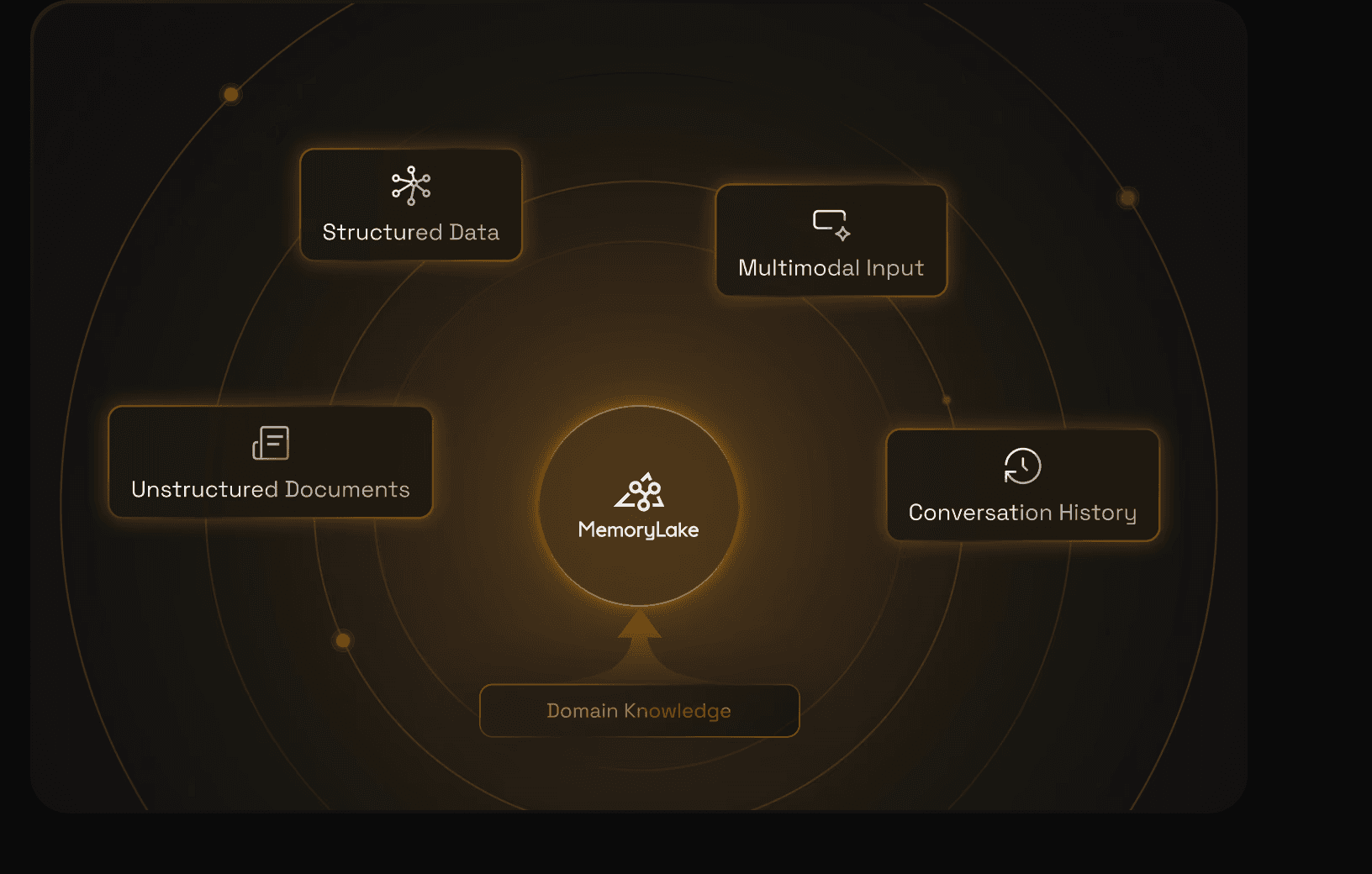
The specially developed MemoryLake-D1 model, created earlier to enhance multimodal data understanding and extraction, is now essential. It accurately extracts textual logic and spreadsheet relationships, transcribes key information from audio/video, and identifies image content, ensuring multimodal data is transformed into reliable, structured memory.
Additionally, MemoryLake organizes all data into easily understandable and usable formats (such as knowledge graphs and summaries) and enables petabyte-scale precision retrieval, ensuring quick access to needed information regardless of data volume.
In the age of LLM, the interaction between Agents and memory is mediated by Code. Therefore, multimodal knowledge processing capabilities also encompass distributed code computation. This ensures timely, smooth, error-free responses when AI calls upon memory, fully adapt to current LLM usage demands , eliminating scenarios where "AI wants to access memory but can't connect or use it."
Memory Retrieval, Computation, and Evaluation Capabilities
MemoryLake supports end-to-end understanding and organization of refined, complete context. Whether for large models or AI agents, it facilitates rapid development of business-related applications, saving time and human effort.
Data sources are precisely traceable, and decision-making processes are auditable and support human-in-the-loop intervention, meeting the stringent, low-tolerance requirements of enterprise operations.
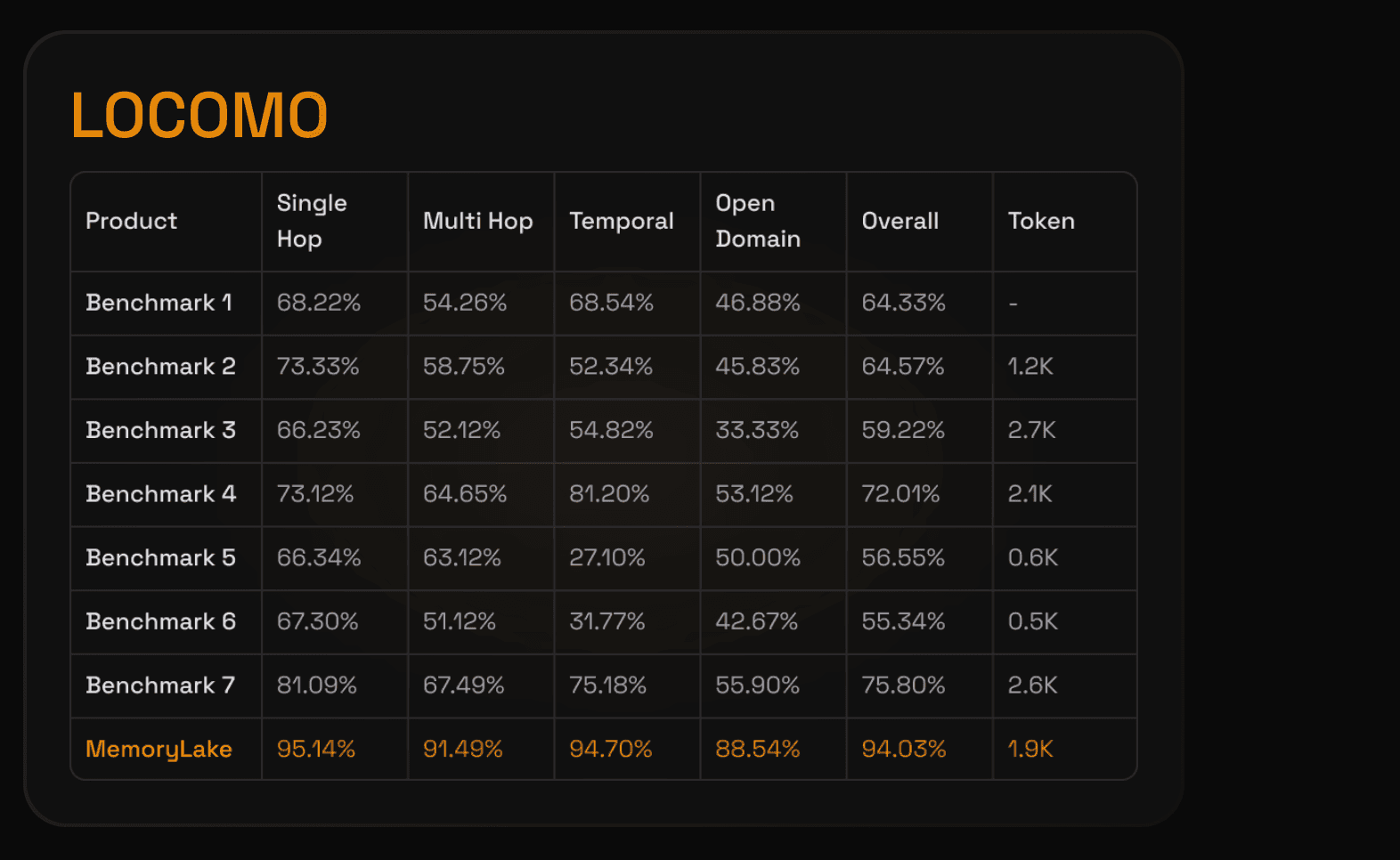
Publicly available information shows that on the challenging LoCoMo long-term conversation memory benchmark (requiring accurate information integration and reasoning across conversations averaging 300 turns, spanning months, and involving multimodal content), the MemoryLake Memory Engine achieved the world's highest comprehensive score of 94.0%.
Crucially, MemoryLake doesn't just retrieve memory; it performs computations based on organized memory. It can execute complex operations and code with both accuracy and flexibility, adapting to diverse and sophisticated enterprise computational needs.
A Lucrative Opportunity in a Multi-Billion Dollar Race
"This is just the starting point." OpenAI CEO Sam Altman has noted that 2026 will be a critical year for Agent Memory to breakthough from "basic viability" to "mature commercial application," with the goal of making AI memory "as natural, persistent, and reliable as human cognition."
Data indicates that by 2028, the global AI solutions market will surpass $632 billion, with the AI memory-related segment exceeding $28 billion.
This is clearly a wide and deep golden opportunity. As Ethan states, "The future of AI is driven by memory."
Recently, leading foundation model companies, traditional data platforms, and cloud vendors have also recognized that AI memory has evolved from conceptual infrastructure to a core enterprise requirement for AI implementation, and they are entering the fray. However, inherent limitations prevent them from easily dominating.
Traditional cloud vendors and data platforms, while deeply experienced in storage and computation, lack deep understanding engines and dynamic management capabilities tailored for multimodal memory, often struggling with complex enterprise-grade memory demands.
Leading foundation model companies, despite possessing powerful generation capabilities, are constrained by data fragmentation, making it difficult to deliver accurate, consistent, and explainable decisions within complex business scenarios. These industry pain points precisely create opportunities for innovative companies with full-stack capabilities to take the lead.
This is the opportunity DataCloud seized. Its integrated technology stack, combining memory management/computation, data-focused large models, and an AI data platform, attracted significant investor interest early on. The company secured tens of millions of dollars in angel funding at a valuation exceeding $200 million. A new funding round is reportedly underway.
Currently, MemoryLake serves over 1.5 million professional users and 15,000 enterprises globally, spanning industries including finance, industrial manufacturing, gaming, education, legal, and e-commerce.
For Executive Decision-Making: A business leader analyzing a project's historical risks and current market trends can rely on MemoryLake to automatically integrate disparate information—project documents, communication logs, industry reports—perform reasoning, and deliver evidence-backed recommendations. Tasks requiring weeks of manual analysis are now completed in hours.
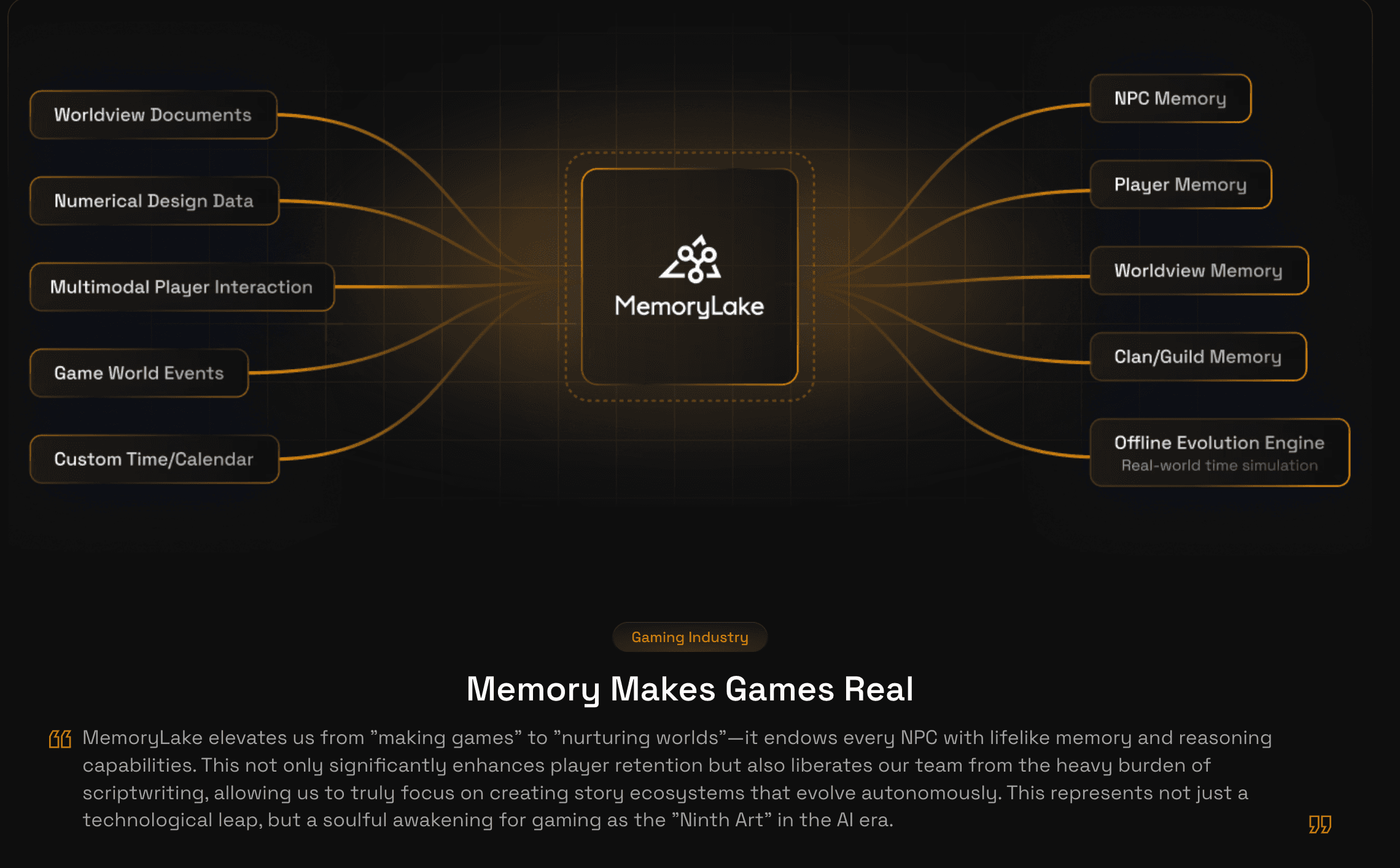
For Immersive Gaming: MemoryLake constructs evolving "world model memory" and "player memory" for NPCs. NPCs remember every key player choice and achievement, using this memory to interact and drive narrative, truly enabling a "thousand players, thousand experiences" paradigm.
For Manufacturing and Finance: It integrates cross-system, cross-temporal "production memory" or "transaction memory." When quality issues arise on the factory floor, root causes are identified instantly. Financial transactions with potential risks trigger real-time alerts. Tasks previously requiring extensive manual investigation are now completed instantaneously by AI, giving enterprises a critical time advantage.
According to official information, during memory retrieval, the MemoryLake Engine returns context-friendly, refined, and complete memories, rather than fragmented, conflicting, or incomplete raw knowledge. This allows models to leverage MemoryLake's petabyte-scale data memory organization capabilities, reducing token consumption and computational costs by an average of over 90%.
Just as the cloud era gave rise to Snowflake and Databricks, the AI era will redefine infrastructure around "memory" as its core.
A new era—where AI can reliably remember and truly think—has arrived.
Official Website: https://memorylake.ai/